
AI Phishing
Clean grammar proves nothing about a request, and a polished email can still carry an unsafe one. AwareX prepares AI-assisted scenarios, reviewed by your team, so people practice verifying the message itself.
Explore the approachPolished language is no longer a reason to trust an email.
A polished email can hide an unsafe request without a spelling mistake. AwareX uses reviewed, AI-assisted scenarios to rehearse independent verification.
Public offsite posts become context for a convincing venue-payment email. The employee must check the request, not just its polished wording.
Fictional workplace example, not a live attack or measured customer result.
- 01 / WHAT ROUTINE TRAINING MISSES
Spotting bad grammar becomes the defense.
A well-written message can remove the surface clues employees learned to rely on.
- 02 / WHEN THE REQUEST FEELS REAL
Credibility can hide an unsafe destination.
A plausible sign-in or document request can expose credentials or business information if the instruction is not independently checked.
- 03 / WHERE AWAREX CHANGES THE REHEARSAL
Match the rehearsal to the changed threat.
AwareX uses public business context to draft realistic email scenarios, keeps human approval in control, and uses responses to guide follow-up.
Routine compliance training vs. AwareX
Compliance learning establishes a foundation. AwareX puts AI behind the rehearsal: it studies your approved context, drafts the scenarios, and adapts what people practice next.
| What matters | Routine compliance training | AwareX approach |
|---|---|---|
| Starting point | A scheduled course built around policies and general awareness. | AI studies your approved business context first, so the first test reflects how you work. |
| Workplace relevance | The same broad examples for every responsibility. | AI drafts role-specific versions for finance, HR, IT, and leadership; your team approves each. |
| What people practice | Recognizing terms and selecting answers in a lesson. | AI adapts sender, story, tone, and difficulty from each response. |
| Follow-through | Completion often becomes the finish line; reinforcement is rarely built in. | AI reads each click, report, and pause, then sets the next round from the missed cue. |
| What success means | Attendance, course completion, and assessment scores. | The decisions people make in rehearsal, tracked by AI across rounds, not one quiz. |
This compares a completion-focused training approach, not every training provider. AI output is reviewed by your team before release, and capabilities and scope are confirmed in your demo. Training does not guarantee attack prevention, compliance, or certification.
From recognizing a message to rehearsing a response
Does the employee verify a polished email rather than trust its tone?
Rehearse the decisionExplain the missed cuePractice again
What is AI Phishing?
Email scenarios that start from context, not templates: an AI agent reads public signals about your organization, drafts the scenario, and your team decides what employees ever see.
Context before drafting
Announcements, job posts, and team pages become the same context an attacker would use, so the lure feels written for this company.
Human-approved before delivery
AI drafts; your team reviews every word. Nothing reaches an inbox without approval.
The decision is the result
Coaching arrives in the moment of the decision, so the lesson is the cue that was missed, not a lecture after the fact.
Public offsite posts become context for a convincing venue-payment email. The employee must check the request, not just its polished wording.
Illustrative example. Context sources and difficulty in scope are confirmed with your team, and every scenario is reviewed and approved before it runs.
How AwareX AI makes it more effective.
No generic templates. AwareX agents read what is happening at your company and build department-specific tests from it.
AI writes the lure an attacker would write.
- Scan the web
- Read the news
- Map the people
- Map the people
- Send for approval
- Company offsite announced for next week
- New funding round closed
- Head of Sales joins from a rival
From: Microsoft 365 <[email protected]>
Subject: Unusual sign-in from the offsite venue
Hi team, following this week's announcement, please action this before end of day. Details are in the attached file.
details.pdf
Awaiting your approvalIllustrative example. Signals, names, and messages are not real customer data.
An AI agent scans public signals (announcements, job posts, and team pages) to build the context a real attacker would use.
AI drafts the scenario; your team reviews and approves every word before it reaches an inbox.
Results feed back into the engine, so the next test reflects what this person actually needs to practice.
AI proposes; people decide. Every scenario is reviewed and approved by your team before it reaches an employee.
Every answer changes the next test.
Each response is read as a signal, not filed away as a score. The AI engine moves each person one step up or down seven difficulty levels, so nobody meets a deepfake call before they can spot a fake invoice, and nobody stays on obvious spam that teaches them nothing.
- Reported it in time
The next test moves a step up the ramp: a more familiar sender, a tighter story, or a second channel arriving behind the first.
- Clicked, then raised it
The level holds. The lesson names the exact cue that was missed, and that cue returns in the next wave until it is recognized on sight.
- Missed it entirely
Coaching comes first, not embarrassment. The next test keeps the same theme with clearer warning signs, then rises again once the habit holds.
Adjustments belong to the person, not the whole company. Your team still reviews and approves every wave before it runs.
- Obvious phishing
- Realistic corporate
- Spear phishing
- Business email compromise
- Executive impersonation
- Multichannel story
- Deepfake + social engineering
Why it matters: a result only means something when you know how hard the test was.
A familiar moment. A decision worth rehearsing.
AI Phishing, rehearsed through the decisions around a marketing offsite and a campaign plan.
- A realistic message lands in the flow of work.
- Each cue is inspected one by one, from the sender to the deadline.
- The safe response is rehearsed: report it, verify it, or ask.
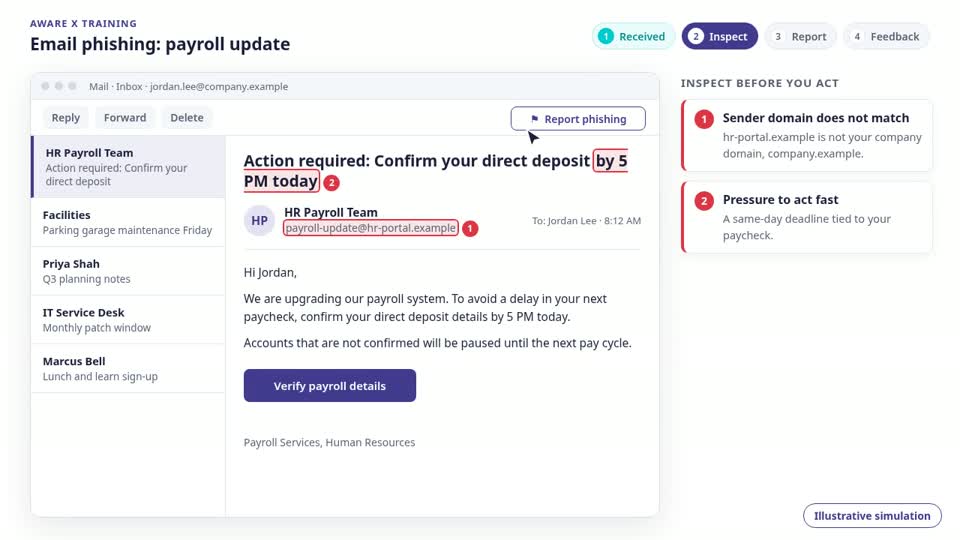
Illustrative screens, not live product screenshots. Messages, identities, and destinations are fictional; no links, payments, approvals, or uploads are active. Confirm capabilities in a demo.
One check today.
A safer routine every day.
Rehearse fluent, believable requests as a recurring fire drill. The habit to practice is independent verification, not proofreading.
Explore the fire-drill approachCaptured platform preview. Figures are example data, not measured customer results.
- 01
A drill, not a checkbox
A signed policy fades within weeks. A rehearsed pause, verify, and report habit holds when a real message lands.
- 02
Practice where decisions happen
Short, contextual exercises arrive in the flow of work, in the channels your teams actually use, instead of a once-a-year course.
- 03
Learn, never blame
A miss is data for the next exercise, not a mark against a person. Repeated practice is what moves the numbers.
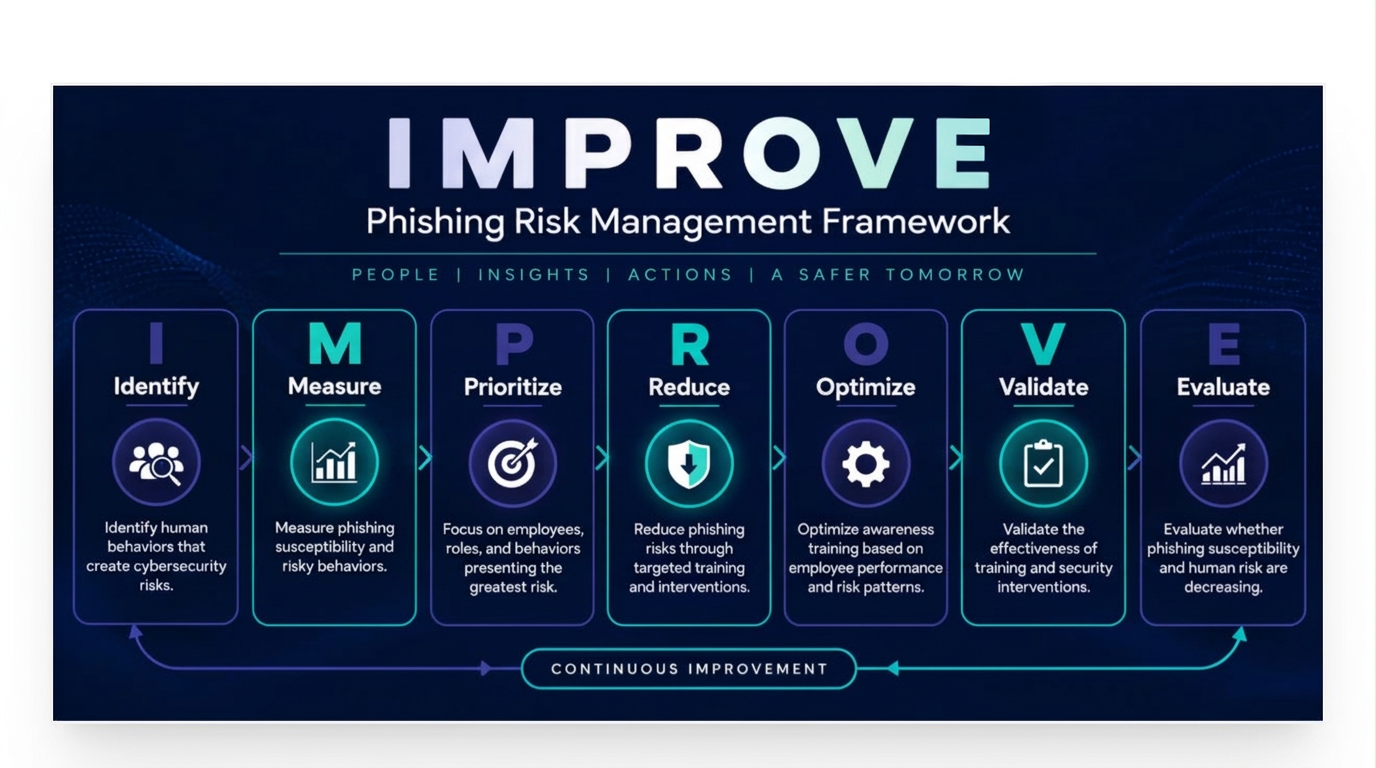
IMPROVE.
One continuous loop.
Identify, Measure, Prioritize, Reduce, Optimize, Validate, and Evaluate. AI connects business context, employee responses, and targeted learning to inform each next test.
Explore related solutions.
Clarity before
the next step.
What is AI phishing?
AI phishing is an email attack where artificial intelligence does the work an attacker would otherwise do by hand: researching the target organization, choosing a plausible story, and drafting the email. The result reads like a genuine workplace message, which is why polished grammar alone is no longer a reliable sign of a legitimate email.
How is an AI phishing email different from a traditional phishing email?
A traditional phishing email is a generic template sent to thousands of people, full of urgency and obvious errors. An AI phishing email is built around the recipient’s context, such as a current project, a real announcement, or a supplier relationship, and arrives written in clean, natural language. The request itself, not the wording, is what deserves scrutiny.
Can email filters stop AI phishing?
Filters still catch many attacks, but AI-generated emails are designed to avoid the signals filters look for: unusual phrasing, spoofed headers, and suspicious attachments. As the writing improves, the last reliable line of defense is the person reading the email and verifying the request through a known channel.
How does AwareX use AI in phishing simulations?
AwareX agents scan public business signals such as announcements, job posts, and team pages, then draft a scenario a real attacker would write from that context. Each simulation is tuned to the recipient’s role and department, and results feed back into the engine so the next test reflects what each person actually needs to practice.
Does AwareX send AI-written emails without anyone reviewing them?
No. Every AI-drafted scenario goes through human review, and your team approves every word before a simulation reaches an inbox. AI proposes the scenario, but people decide what your employees see.
How often should we run AI phishing simulations?
A regular rhythm, such as a monthly cycle, works better than occasional campaigns, because the goal is a habit rather than a one-time test. Because AwareX adapts difficulty and content to previous responses, repeated simulations keep presenting fresh decisions instead of the same template, so employees stay alert without learning to recognize one specific test.