
Multi-Attack Vector Phishing Simulation
A message, a text, and a follow-up call can work together until familiarity feels like trust. AwareX rehearses the whole connected story, with your team reviewing every channel.
Explore the approachYour training ends at the email. The attack may not.
A convincing email, text, and call can turn familiarity into unsafe trust. AwareX rehearses one connected, human-reviewed attack story.
During a marketing offsite, an invoice email is followed by a voice note and a request to approve access. Each touchpoint reinforces the same unverified instruction.
Fictional workplace example, not a live attack or measured customer result.
- 01 / WHAT ROUTINE TRAINING MISSES
Separate tests. A connected blind spot.
Independent templates test isolated messages, not the story an employee has already started to believe.
- 02 / WHEN THE REQUEST FEELS REAL
A second channel can make the first seem legitimate.
A follow-up call can push an unverified request toward an access approval, information disclosure, or payment.
- 03 / WHERE AWAREX CHANGES THE REHEARSAL
Rehearse one connected story.
AwareX shapes approved business-context scenarios across channels, so teams practice verifying the instruction rather than trusting the sequence.
Routine compliance training vs. AwareX
Compliance learning establishes a foundation. AwareX puts AI behind the rehearsal: it studies your approved context, drafts the scenarios, and adapts what people practice next.
| What matters | Routine compliance training | AwareX approach |
|---|---|---|
| Starting point | A scheduled course built around policies and general awareness. | AI studies your approved business context first, so the first test reflects how you work. |
| Workplace relevance | The same broad examples for every responsibility. | AI drafts role-specific versions for finance, HR, IT, and leadership; your team approves each. |
| What people practice | Recognizing terms and selecting answers in a lesson. | AI adapts sender, story, tone, and difficulty from each response. |
| Follow-through | Completion often becomes the finish line; reinforcement is rarely built in. | AI reads each click, report, and pause, then sets the next round from the missed cue. |
| What success means | Attendance, course completion, and assessment scores. | The decisions people make in rehearsal, tracked by AI across rounds, not one quiz. |
This compares a completion-focused training approach, not every training provider. AI output is reviewed by your team before release, and capabilities and scope are confirmed in your demo. Training does not guarantee attack prevention, compliance, or certification.
From recognizing a message to rehearsing a response
Does the employee verify the request when a second channel appears to confirm it?
Rehearse the decisionExplain the missed cuePractice again
What is Multi-Attack Vector Simulation?
One exercise that rehearses how an attack really arrives: not a single email, but the same story on several channels at once. Every touchpoint asks for the same unverified thing, and the result is what each person does with it.
One story
A scenario is written once and carried by every channel in play, so the invoice email, the follow-up voice note, and the text asking for the plan all point at the same request.
Grounded in something true
AwareX AI agents read your public website and news to build the context, then your team reviews and approves every step before anything reaches an inbox.
The decision is the result
The useful measure is not whether someone spots a fake, but whether they verify before paying, approving, or uploading. That is the habit the exercise rehearses.
During a marketing offsite, an invoice email is followed by a voice note and a request to approve access. Each touchpoint reinforces the same unverified instruction.
Illustrative example. Channels, departments, and languages in scope are confirmed with your team, and every scenario is reviewed and approved before it runs.
New to the term? Read the guide: How to run a phishing test
How AwareX AI makes it more effective.
First, five agents turn real news into a real test.
No generic templates. AwareX agents read what is happening at your company and build department-specific tests from it.
- Scan the web
- Read the news
- Map the people
- Chain the channels
- Send for approval
- Company offsite announced for next week
- New funding round closed
- Head of Sales joins from a rival
- Email · CFO
Offsite vendor deposit: please release today - SMS · CFO
Just sent you the deposit email. Please release it before 3 pm. - Call · “IT service desk”
Confirming your vendor portal login so the payment can go through.
Three touchpoints · one campaign CUS
Awaiting your approval CUSIllustrative example. Signals, names, and messages are not real customer data.
Then every answer changes the next test.
Each response is read as a signal, not filed away as a score. A clean report, a click followed by a report, a lure opened and ignored: the engine weighs all three and moves that person one step up or down the seven levels below. The change is small and deliberate, so nobody meets a deepfake call before they can spot a fake invoice, and nobody stays on obvious spam that teaches them nothing.
- Reported it in time
The next test moves a step up the ramp: a more familiar sender, a tighter story, or a second channel arriving behind the first.
- Clicked, then raised it
The level holds. The lesson names the exact cue that was missed, and that cue returns in the next wave until it is recognized on sight.
- Missed it entirely
Coaching comes first, not embarrassment. The next test keeps the same theme with clearer warning signs, then rises again once the habit holds.
Adjustments belong to the person, not the whole company. Your team still reviews and approves every wave before it runs.
- Obvious phishing
- Realistic corporate
- Spear phishing
- Business email compromise
- Executive impersonation
- Multichannel story
- Deepfake + social engineering
Why it matters: a result only means something when you know how hard the test was.
- 6 scenarios from 8 crawled pages (example)
- Up to 3 departments per wave
- Likelihood × impact scoring, 0 to 100
- Promote, edit, regenerate, or reject each lure
It learns your company before it tests it.
The engine learns a company from its website in under a minute, then writes lures from your own crawled context, signatures, and logo.
- 01
Crawl + live web research
Add up to 5 target domains. Pages are indexed and merged into one business context: departments, products, and tone.
- 02
Lookalike domain scan
Surfaces typosquat and lookalike domains an attacker would register, then lets you register them defensively.
- 03
Locked sending identity
The primary domain drives branding and the sender identity, so every lure is on-brand and consented.
AI reads the business context (role, department, and current activity) and drafts one connected story across every channel, instead of five unrelated templates.
Each touchpoint adapts to the response before it: open the email and the follow-up voice note references it.
Every scenario is drafted by AI and approved by your team before anyone sees it.
Six places AI does the work a red team used to.
Specialized agents handle context, scenarios, lures, risk, lookalike domains, and follow-up. Each card names the human task it takes over.
- 01
Context engine
Crawls your domain and runs live web research to write the business context (departments, products, and tone) that every scenario is grounded in.
Used to taketwo analysts and three days on your website
- 02
Scenario engine
Vector-specific sub-agents draft, score, and validate attack scenarios against the engagement scope; each carries a likelihood × impact score and a confidence value.
Used to takea whiteboard and a fortnight of meetings
- 03
Lure composer
Generates on-brand emails with real signatures, lookalike senders, and document-notice attachments, then a debrief page in the same voice.
Used to takea designer, a copywriter, and a proofreader per campaign
- 04
Risk calibration
The AI risk estimate is shown next to actual risk, so you can see how well the model predicts your people.
Used to takea hunch about who is most at risk
- 05
Lookalike radar
Discovers typosquat and lookalike domains an attacker would register and hands them to the defensive registration flow.
Used to takesomeone remembering to check for typosquats
- 06
Targeting & routing
Ranks offenders and departments, sets reminder cadence, and decides who needs training after each wave, with no manual triage.
Used to takea spreadsheet and a follow-up queue
Your model, your data boundary: every agent can run on your preferred model, including a fully local one. Keys are encrypted and never returned to the browser, and agent logs expose every AI decision for audit.
AI proposes; people decide. Every scenario is reviewed and approved by your team before it reaches an employee.
A familiar moment. A decision worth rehearsing.
Multi-Attack Vector Simulation, rehearsed through the decisions around a marketing offsite and a campaign plan.
- A realistic message lands in the flow of work.
- Each cue is inspected one by one, from the sender to the deadline.
- The safe response is rehearsed: report it, verify it, or ask.
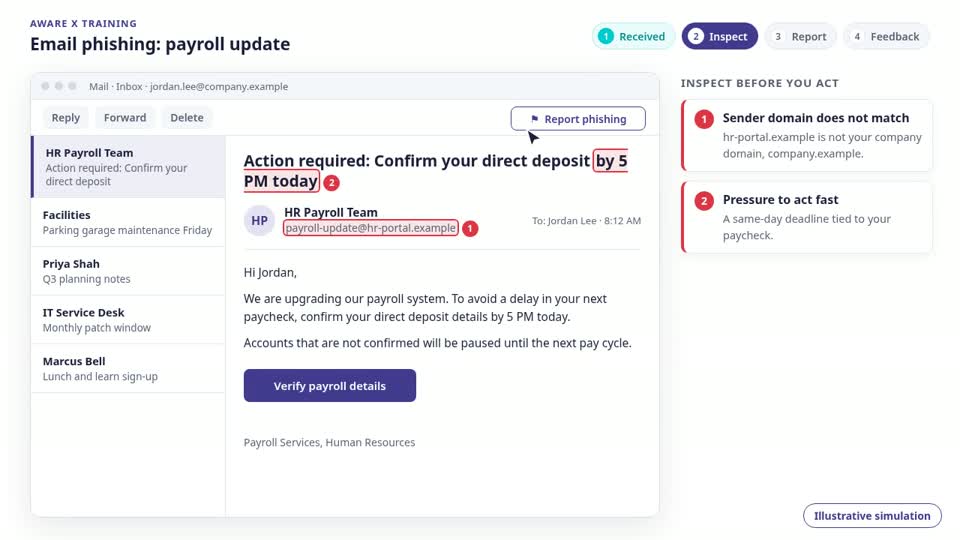
Verify new bank details first.
Illustrative screens, not live product screenshots. Messages, identities, and destinations are fictional; no links, payments, approvals, or uploads are active. Confirm capabilities in a demo.
One check today.
A safer routine every day.
A fire drill rehearses the whole escape route. Practice the connected email, text, and voice decisions too, not just the first message.
Explore the fire-drill approachCaptured platform preview. Figures are example data, not measured customer results.
- 01
A drill, not a checkbox
A signed policy fades within weeks. A rehearsed pause, verify, and report habit holds when a real message lands.
- 02
Practice where decisions happen
Short, contextual exercises arrive in the flow of work, in the channels your teams actually use, instead of a once-a-year course.
- 03
Learn, never blame
A miss is data for the next exercise, not a mark against a person. Repeated practice is what moves the numbers.
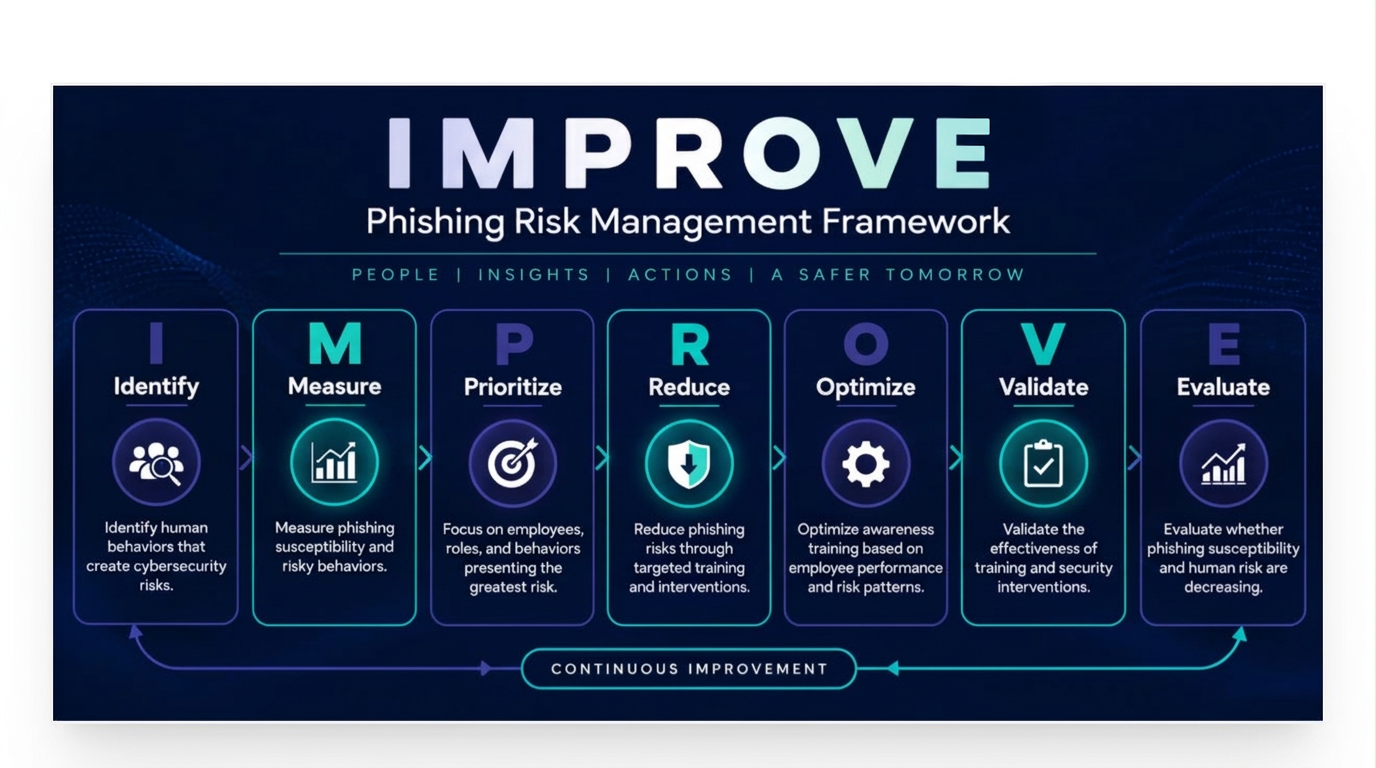
IMPROVE.
One continuous loop.
Identify, Measure, Prioritize, Reduce, Optimize, Validate, and Evaluate. AI connects business context, employee responses, and targeted learning to inform each next test.
Explore related solutions.
Clarity before
the next step.
What is a multi-attack vector phishing simulation?
A multi-attack vector phishing simulation rehearses one deceptive business story across several channels, such as email, SMS, voice, and QR codes. It tests whether employees verify the underlying request when successive messages appear to support each other.
Why do attackers combine email, text messages, and phone calls?
A follow-up call or text can make an earlier email seem credible and increase pressure to act. Agreement between messages is not independent verification when the attacker controls those channels. Employees should confirm the request through an established contact or system.
What is an example of a multi-channel phishing scenario?
An invoice email during an offsite is followed by a voice message and a request to approve access. Each touchpoint reinforces the same payment story. The safer decision is to keep approval controls intact and verify outside the incoming conversation.
How does AwareX build connected phishing simulations?
AwareX uses approved public business context, roles, and departments to draft one connected scenario rather than unrelated channel templates. Your team reviews and approves the scenario before employees receive it. Responses inform subsequent rehearsal and learning.
What should employees practice in a multi-vector simulation?
Employees should practice pausing across channels, recognizing repeated pressure, and checking a request through a known contact. The key question is whether the instruction is authorized, not whether the sender can repeat a convincing story by email and phone.
How should organizations evaluate multi-channel phishing training?
Review decisions at each touchpoint and whether employees ultimately verify, report, or comply with the unsafe request. Compare repeated rehearsals to identify where additional coaching is needed. A single email click does not describe the whole connected scenario.