Vishing: Voice Phishing Awareness Training
A confident caller can talk an employee into handing over access. AwareX rehearses protecting codes, ending the call, and verifying through a known channel.
Explore the approachYour caller sounds confident. Your process must be stronger.
An authoritative caller can turn a conversation into unauthorized access. AwareX rehearses protecting codes, ending the call, and verifying independently.
During the offsite review, a caller claiming to be IT says the campaign account is compromised and asks a finance employee to read out a one-time code. The employee ends the call and contacts the service desk through the listed number.
Fictional workplace example, not a live attack or measured customer result.
- 01 / WHAT ROUTINE TRAINING MISSES
The course never asks someone to end the call.
Knowledge of phishing terms does not rehearse refusing a code request or calling back through a trusted number.
- 02 / WHEN THE REQUEST FEELS REAL
Authority can turn conversation into access.
Sharing a one-time code or approving a reset for an unverified caller can put an account at risk.
- 03 / WHERE AWAREX CHANGES THE REHEARSAL
Practice the callback under pressure.
AwareX builds reviewed voice scenarios from business context and focuses learning on verification, code protection, and reporting.
Routine compliance training vs. AwareX
Compliance learning establishes a foundation. AwareX puts AI behind the rehearsal: it studies your approved context, drafts the scenarios, and adapts what people practice next.
| What matters | Routine compliance training | AwareX approach |
|---|---|---|
| Starting point | A scheduled course built around policies and general awareness. | AI studies your approved business context first, so the first test reflects how you work. |
| Workplace relevance | The same broad examples for every responsibility. | AI drafts role-specific versions for finance, HR, IT, and leadership; your team approves each. |
| What people practice | Recognizing terms and selecting answers in a lesson. | AI adapts sender, story, tone, and difficulty from each response. |
| Follow-through | Completion often becomes the finish line; reinforcement is rarely built in. | AI reads each click, report, and pause, then sets the next round from the missed cue. |
| What success means | Attendance, course completion, and assessment scores. | The decisions people make in rehearsal, tracked by AI across rounds, not one quiz. |
This compares a completion-focused training approach, not every training provider. AI output is reviewed by your team before release, and capabilities and scope are confirmed in your demo. Training does not guarantee attack prevention, compliance, or certification.
From recognizing a message to rehearsing a response
Will the employee end the call and contact the service desk through a known number?
Rehearse the decisionExplain the missed cuePractice again
Relevant context.
Safer decisions.
A confident voice uses urgency, authority, and a familiar story to push a decision before anyone verifies the caller.
During the offsite review, a caller claiming to be IT says the campaign account is compromised and asks a finance employee to read out a one-time code. The employee ends the call and contacts the service desk through the listed number.
How AwareX AI makes it more effective.
No generic templates. AwareX agents read what is happening at your company and build department-specific tests from it.
A confident voice, a request made aloud.
- Scan the web
- Read the news
- Map the people
- Script the call
- Send for approval
- Company offsite announced for next week
- New funding round closed
- Head of Sales joins from a rival
Caller: IT service desk
Account locked: read out the one-time code
“Hi, this is a quick one. I just need you to confirm a few details for me before the review closes.”
Call script · 2 min
Awaiting your approvalIllustrative example. Signals, names, and messages are not real customer data.
AI builds each call from live business context (offsites, system changes, and finance cycles) so the caller's story sounds plausible.
Pressure, seniority, and urgency adapt to the recipient's role instead of one generic script.
Every response shapes the coaching and the next scenario that person sees.
AI proposes; people decide. Every scenario is reviewed and approved by your team before it reaches an employee.
Every answer changes the next test.
Each response is read as a signal, not filed away as a score. The AI engine moves each person one step up or down seven difficulty levels, so nobody meets a deepfake call before they can spot a fake invoice, and nobody stays on obvious spam that teaches them nothing.
- Reported it in time
The next test moves a step up the ramp: a more familiar sender, a tighter story, or a second channel arriving behind the first.
- Clicked, then raised it
The level holds. The lesson names the exact cue that was missed, and that cue returns in the next wave until it is recognized on sight.
- Missed it entirely
Coaching comes first, not embarrassment. The next test keeps the same theme with clearer warning signs, then rises again once the habit holds.
Adjustments belong to the person, not the whole company. Your team still reviews and approves every wave before it runs.
- Obvious phishing
- Realistic corporate
- Spear phishing
- Business email compromise
- Executive impersonation
- Multichannel story
- Deepfake + social engineering
Why it matters: a result only means something when you know how hard the test was.
A familiar moment. A decision worth rehearsing.
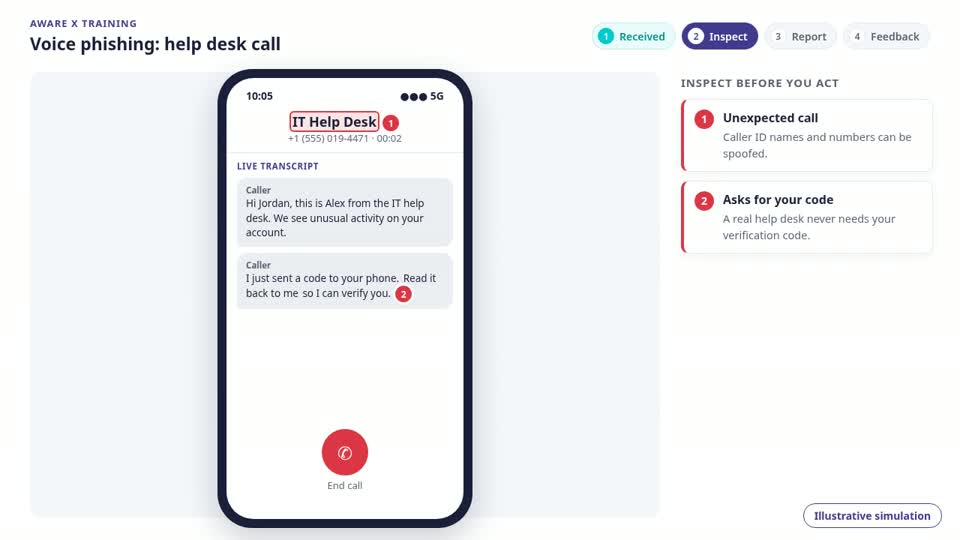
Vishing, rehearsed through the decisions around a marketing offsite and a campaign plan.
- A realistic message lands in the flow of work.
- Each cue is inspected one by one, from the sender to the deadline.
- The safe response is rehearsed: report it, verify it, or ask.
A person reviews every scenario.
Illustrative screens, not live product screenshots. Messages, identities, and destinations are fictional; no links, payments, approvals, or uploads are active. Confirm capabilities in a demo.
One check today.
A safer routine every day.
A voice fire drill rehearses saying no, protecting codes, and calling back. Practice the words before the real caller supplies the pressure.
Explore the fire-drill approachCaptured platform preview. Figures are example data, not measured customer results.
- 01
A drill, not a checkbox
A signed policy fades within weeks. A rehearsed pause, verify, and report habit holds when a real message lands.
- 02
Practice where decisions happen
Short, contextual exercises arrive in the flow of work, in the channels your teams actually use, instead of a once-a-year course.
- 03
Learn, never blame
A miss is data for the next exercise, not a mark against a person. Repeated practice is what moves the numbers.
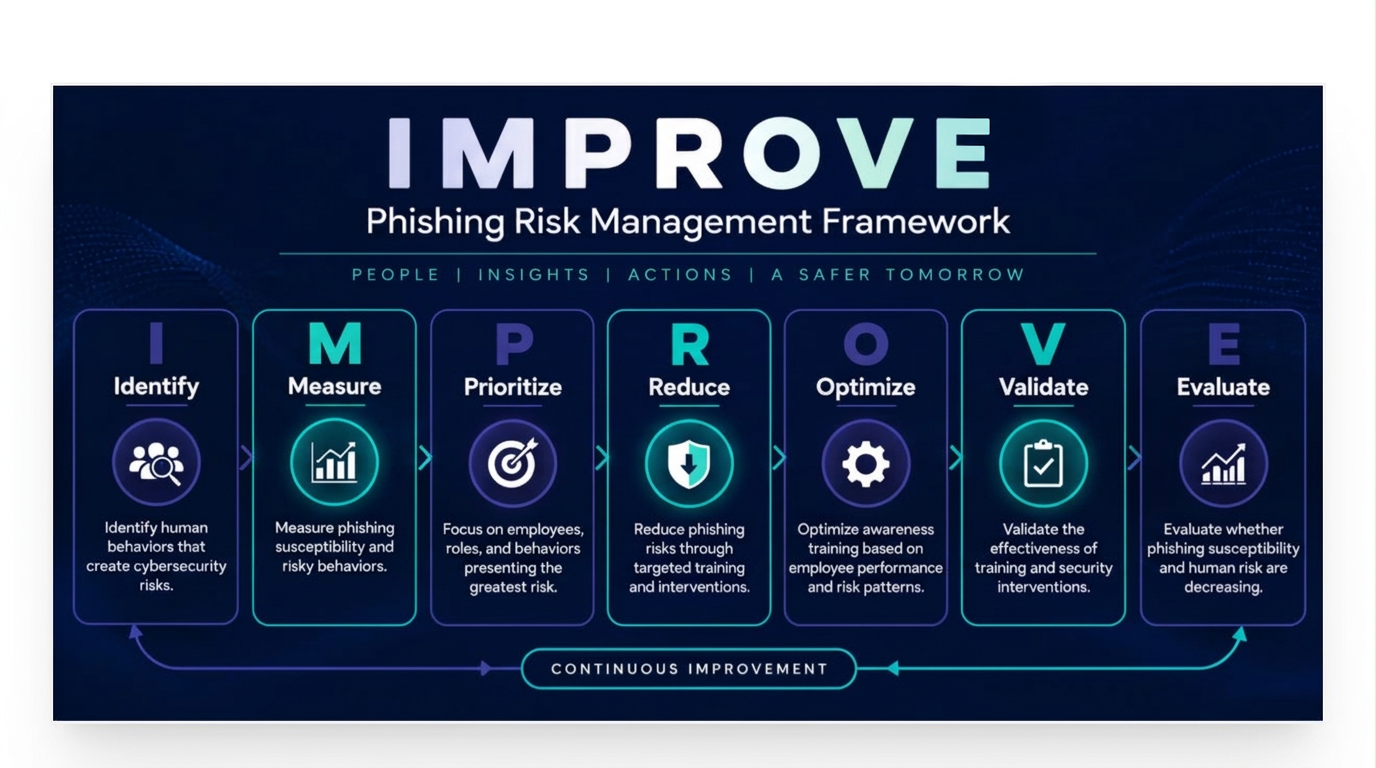
IMPROVE.
One continuous loop.
Identify, Measure, Prioritize, Reduce, Optimize, Validate, and Evaluate. AI connects business context, employee responses, and targeted learning to inform each next test.
AwareX is a human risk management platform.
One platform to assess, manage, and reduce the cyber risk that comes from human behavior, so the attacks it rehearses are the attacks that actually happen.
Phishing simulation
Authorized email simulations, AI-drafted from your business context, scoped by department.
Human risk assessment
Composite risk score from every send, click, credential, and report, trended by department.
Awareness & targeted training
Micro-modules with quiz and reminders, assigned to the people an assessment shows need them.
Analytics & reporting
Dashboards, funnels, department heatmaps, and board-ready PDF export.
PhishRadar
Lookalike-domain discovery and defensive registration: a control, not just a test.
Integration & governance
Microsoft Entra / AD sync, append-only audit trail, seat licensing, role-based admin.
AI you control
Default model, your own provider, or a fully local LLM; every AI decision logged.
SaaS or on-premises
Cloud or air-gapped license file. Your data stays where you need it.
Identify · Simulate · Measure · Improve in one governed, five-step pipeline.
Explore related solutions.
Clarity before
the next step.
What is vishing, or voice phishing?
Vishing is phishing conducted through voice calls or voice messages. An attacker uses apparent authority, urgency, or a familiar story to obtain sensitive information or influence an unsafe action. A confident caller is not proof of an authorized request.
What are common workplace vishing examples?
Examples include a caller impersonating IT and requesting a one-time code, a supposed executive demanding an urgent payment, or a supplier asking for a bank-detail change. Each request should follow the normal verification and approval process.
Can employees trust caller ID or a familiar voice?
Not on its own. Caller ID can be spoofed, and a familiar-sounding voice does not establish identity or authorization. For sensitive instructions, end the incoming call and contact the person or service desk through a number you already trust.
What should employees do when a caller asks for an MFA code?
Do not read out the code or approve an unexpected sign-in. End the call, contact the listed service desk independently, and report the request. If information was already shared, notify the security team immediately.
How does AwareX vishing simulation train employees?
AwareX proposes reviewed call scenarios around plausible business events and role-specific pressure. The rehearsal focuses on protecting codes, keeping approval controls intact, and calling back through a trusted channel. Responses guide follow-up coaching.
How does vishing relate to AI voice impersonation?
Vishing describes the voice-based attack channel; AI voice impersonation is one technique an attacker may use. Ordinary callers can also deceive employees. Training should focus on verifying sensitive requests rather than trying to decide whether every voice is synthetic.