
Spear Phishing: Simulation and Awareness Training
The spear phishing email your teams will actually fall for. Customized by department, tuned by tone, built from your real context. Because AI-powered attackers already do the same. Sent by you first.
Explore the approachOne generic email cannot test a targeted attack.
A role-specific request can bypass the suspicion a generic test teaches. AwareX rehearses targeted emails your team reviews before release.
A finance employee receives a 25K USD venue invoice while the team is offsite. The timing is plausible, but the payment instruction bypasses the agreed approval process.
Fictional workplace example, not a live attack or measured customer result.
- 01 / WHAT ROUTINE TRAINING MISSES
Everyone gets the same lure.
Generic training often overlooks the responsibilities and trusted relationships that make a targeted email convincing.
- 02 / WHEN THE REQUEST FEELS REAL
Relevance can bypass suspicion.
An email tied to current work can encourage a payment change, a sensitive upload, or a sign-in before the sender is verified.
- 03 / WHERE AWAREX CHANGES THE REHEARSAL
Make the rehearsal personal to the role.
AwareX shapes the audience, sender, story, tone, and difficulty around the workplace decision, with your team reviewing before release.
Routine compliance training vs. AwareX
Compliance learning establishes a foundation. AwareX puts AI behind the rehearsal: it studies your approved context, drafts the scenarios, and adapts what people practice next.
| What matters | Routine compliance training | AwareX approach |
|---|---|---|
| Starting point | A scheduled course built around policies and general awareness. | AI studies your approved business context first, so the first test reflects how you work. |
| Workplace relevance | The same broad examples for every responsibility. | AI drafts role-specific versions for finance, HR, IT, and leadership; your team approves each. |
| What people practice | Recognizing terms and selecting answers in a lesson. | AI adapts sender, story, tone, and difficulty from each response. |
| Follow-through | Completion often becomes the finish line; reinforcement is rarely built in. | AI reads each click, report, and pause, then sets the next round from the missed cue. |
| What success means | Attendance, course completion, and assessment scores. | The decisions people make in rehearsal, tracked by AI across rounds, not one quiz. |
This compares a completion-focused training approach, not every training provider. AI output is reviewed by your team before release, and capabilities and scope are confirmed in your demo. Training does not guarantee attack prevention, compliance, or certification.
From recognizing a message to rehearsing a response
Will the recipient keep the verification process intact when the request fits their job?
Rehearse the decisionExplain the missed cuePractice again
What is Spear Phishing?
A targeted email that looks like it belongs in the recipient's inbox. Tailored to the role, timed to what's new, and grounded in real business context, it makes a risky request feel routine. The exercise rehearses the moment someone decides whether to trust it.
Written for the role
Every request fits the work in front of the person reading it. Finance sees a supplier payment. HR sees a candidate resume. Engineering sees a repository alert.
Grounded in something true
The context comes from your organization's real activity, then your team reviews and approves every scenario before it reaches an inbox.
The decision is the result
The useful measure is not spotting the fake, but verifying a payment or approval through a known contact before acting.
A finance employee receives a 25K USD venue invoice while the team is offsite. The timing is plausible, but the payment instruction bypasses the agreed approval process.
Illustrative example. Departments, difficulty, and languages in scope are confirmed with your team, and every scenario is reviewed and approved before it runs.
AI spear phishing gets more clicks.
Source: Heiding et al., spear phishing study (2024)
AI-automated spear phishing
Generic phishing
How AwareX AI makes it more effective.
Relevant to the role. Responsive to the person. Focused on the next decision.
Attackers customize. So do you.
Target departments, pick the sender, set the tone, and let difficulty adapt. AwareX agents write the scenario from what is happening at your company.
The sender your people already trust.
Rises or falls with each person's previous responses.
Illustrative example. Signals, names, and messages are not real customer data.
- 01CONTEXT
An email that fits the work.
AI writes for the recipient’s role and current work, not one template for everyone.
- 02ADAPTATION
A test that adjusts.
Difficulty rises or falls with previous responses, keeping the assessment relevant rather than repetitive.
- 03COACHING
Learning at the moment it matters.
Immediate coaching explains the missed cues, so the next decision can be safer.
Illustrative learning examples, not live campaign results.
AI proposes. Your team decides.Every scenario is reviewed and approved by your team before it reaches an employee.
Every answer changes the next test.
Each response is read as a signal, not filed away as a score. The AI engine moves each person one step up or down seven difficulty levels, so nobody meets a deepfake call before they can spot a fake invoice, and nobody stays on obvious spam that teaches them nothing.
- Reported it in time
The next test moves a step up the ramp: a more familiar sender, a tighter story, or a second channel arriving behind the first.
- Clicked, then raised it
The level holds. The lesson names the exact cue that was missed, and that cue returns in the next wave until it is recognized on sight.
- Missed it entirely
Coaching comes first, not embarrassment. The next test keeps the same theme with clearer warning signs, then rises again once the habit holds.
Adjustments belong to the person, not the whole company. Your team still reviews and approves every wave before it runs.
- Obvious phishing
- Realistic corporate
- Spear phishing
- Business email compromise
- Executive impersonation
- Multichannel story
- Deepfake + social engineering
Why it matters: a result only means something when you know how hard the test was.
A familiar moment. A decision worth rehearsing.
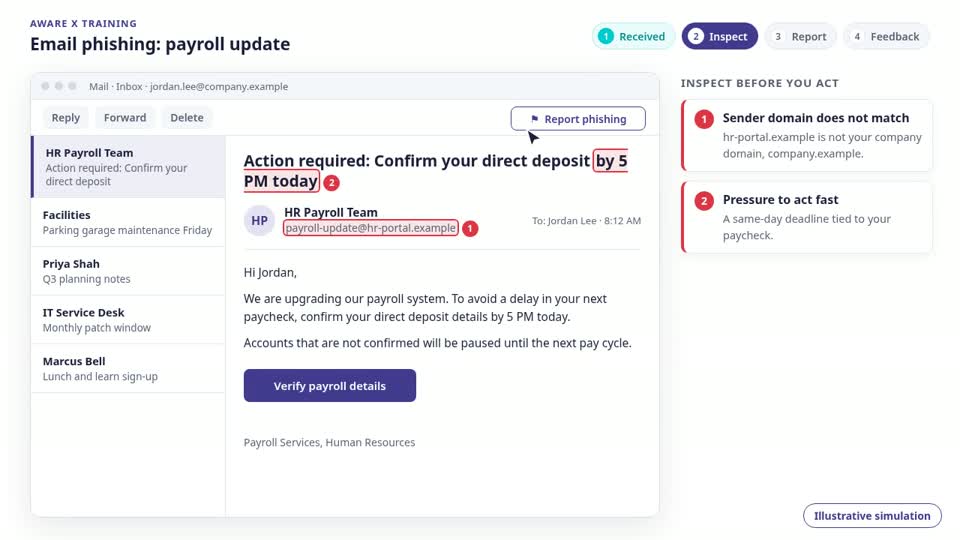
Spear Phishing, rehearsed through the decisions around a marketing offsite and a campaign plan.
- A realistic message lands in the flow of work.
- Each cue is inspected one by one, from the sender to the deadline.
- The safe response is rehearsed: report it, verify it, or ask.
Verify new bank details first.
Illustrative screens, not live product screenshots. Messages, identities, and destinations are fictional; no links, payments, approvals, or uploads are active. Confirm capabilities in a demo.
Every result becomes the lesson.
After every test, everyone gets a short lesson built from what they did: missed, reported, or spotted.
Teach the action.
Not just the definition.
The path is the same for everyone: report it, learn the signal, and meet it again in the next test. What changes is where the lesson starts.
- 01Report in one click
The moment a test feels wrong, reporting it is the win.
- 02Learn in the moment
A short lesson on the exact signal follows, missed, reported, or spotted.
- 03Practice again
The next test arrives harder, so the action becomes a reflex.
“Please use our updated bank details for today's payment.”
Report, then learn
A payment change paired with urgency.
One click reports the email. A two-minute lesson on payment-change requests follows.
One check today.
A safer routine every day.
Give every role its own fire drill. Rehearse the credible request, teach the missed cue, and revisit the decision.
Explore the fire-drill approachCaptured platform preview. Figures are example data, not measured customer results.
- 01
A drill, not a checkbox
A signed policy fades within weeks. A rehearsed pause, verify, and report habit holds when a real message lands.
- 02
Practice where decisions happen
Short, contextual exercises arrive in the flow of work, in the channels your teams actually use, instead of a once-a-year course.
- 03
Learn, never blame
A miss is data for the next exercise, not a mark against a person. Repeated practice is what moves the numbers.
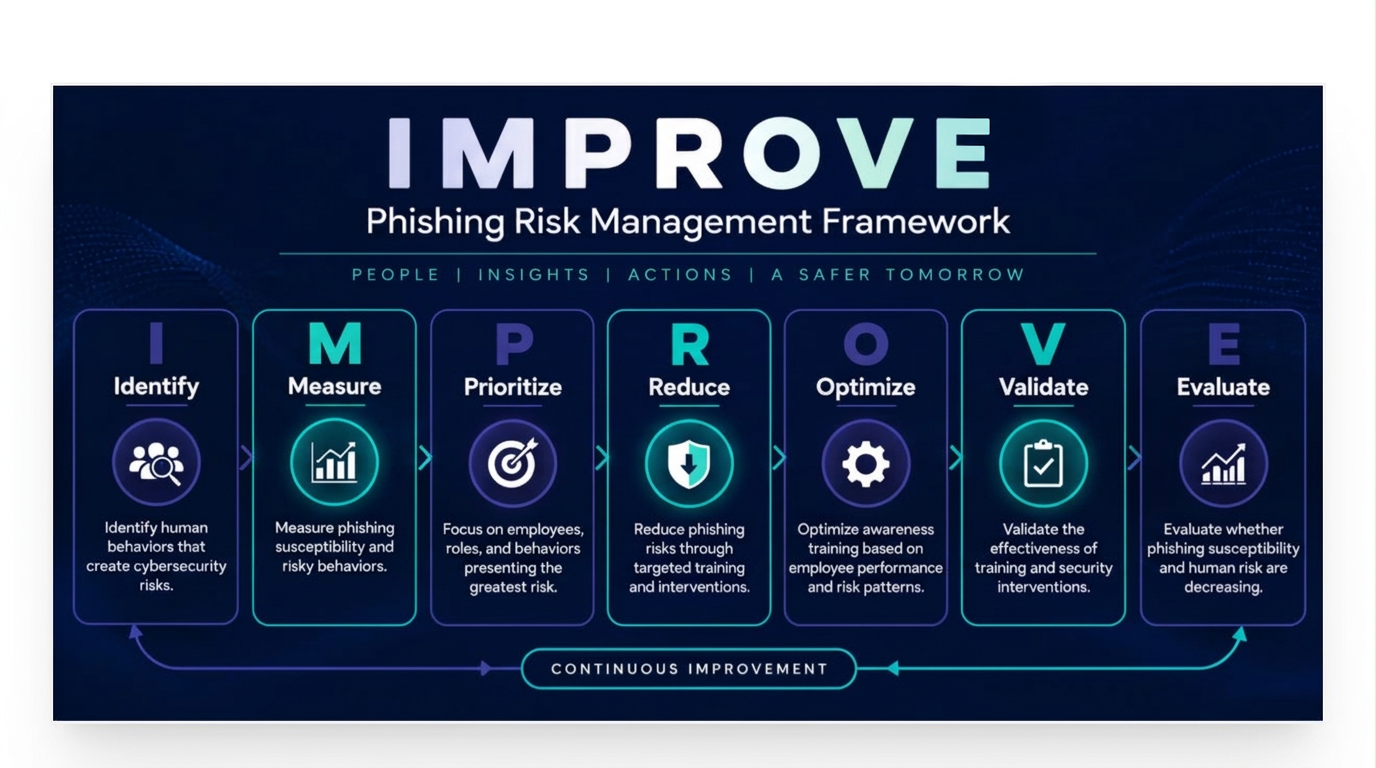
IMPROVE.
One continuous loop.
Identify, Measure, Prioritize, Reduce, Optimize, Validate, and Evaluate. AI connects business context, employee responses, and targeted learning to inform each next test.
Explore related solutions.
Clarity before
the next step.
What is spear phishing?
Spear phishing is a targeted phishing attack tailored to a specific person or team. An attacker uses details about the recipient’s role, responsibilities, or current work to make a deceptive request appear relevant and legitimate.
How is spear phishing different from phishing and whaling?
Phishing is the broader category of deceptive messages used to obtain information, access, or another unsafe action. Spear phishing targets a specific recipient using researched context. Whaling is spear phishing focused on senior executives or other high-value decision-makers.
What are common workplace spear phishing examples?
Examples include a supplier-payment change sent to finance, a candidate document sent to HR, or a repository alert sent to engineering. The request matches the recipient’s job but may bypass an approval process, lead to an unfamiliar sign-in page, or ask for sensitive information.
How can employees recognize a well-written spear phishing email?
Check what the message asks you to do, not just its grammar or familiarity. Verify unexpected payment changes, access requests, and sensitive uploads through a known contact or official system. Use contact details you already trust, not those supplied in the message.
How does AwareX spear phishing simulation work?
AwareX shapes reviewed simulations around role-specific requests and approved business context. Your team approves the scenario before delivery. Responses guide difficulty and coaching that explains the verification cues behind the decision.
How does AI affect spear phishing training?
AI can help attackers research public signals and draft fluent, personalized messages at scale. Training should therefore include credible contextual requests, not rely on obvious spelling mistakes. AwareX uses AI-assisted drafting with human approval to rehearse those decisions.