
Email Phishing: Simulation and Awareness Training
Phishing emails have stopped looking suspicious. They read clean, sound routine, and pass at a glance. AwareX sends them first, so every click becomes a lesson before it costs your organization.
Explore the approachThe dangerous email may be the one that looks routine.
A routine-looking email can expose credentials or confidential information. AwareX rehearses credible workplace requests and teaches the safer response.
An email claiming to be from HR asks your team to confirm payroll bank details through a new link. The wording is clean. The deadline sounds routine. The destination has not been verified.
Fictional workplace example, not a live attack or measured customer result.
- 01 / WHAT ROUTINE TRAINING MISSES
Obvious warning signs become the lesson.
Employees may learn to reject suspicious-looking emails without checking ordinary-looking requests for access or information.
- 02 / WHEN THE REQUEST FEELS REAL
A routine request can carry an unsafe instruction.
A false HR update or IT notice can lead to credential exposure or a confidential upload through an unapproved destination.
- 03 / WHERE AWAREX CHANGES THE REHEARSAL
Practice the email your teams could believe.
AwareX builds reviewed workplace scenarios and records responses. Employees who click receive a short lesson on the cues they missed.
Routine compliance training vs. AwareX
Compliance learning establishes a foundation. AwareX puts AI behind the rehearsal: it studies your approved context, drafts the scenarios, and adapts what people practice next.
| What matters | Routine compliance training | AwareX approach |
|---|---|---|
| Starting point | A scheduled course built around policies and general awareness. | AI studies your approved business context first, so the first test reflects how you work. |
| Workplace relevance | The same broad examples for every responsibility. | AI drafts role-specific versions for finance, HR, IT, and leadership; your team approves each. |
| What people practice | Recognizing terms and selecting answers in a lesson. | AI adapts sender, story, tone, and difficulty from each response. |
| Follow-through | Completion often becomes the finish line; reinforcement is rarely built in. | AI reads each click, report, and pause, then sets the next round from the missed cue. |
| What success means | Attendance, course completion, and assessment scores. | The decisions people make in rehearsal, tracked by AI across rounds, not one quiz. |
This compares a completion-focused training approach, not every training provider. AI output is reviewed by your team before release, and capabilities and scope are confirmed in your demo. Training does not guarantee attack prevention, compliance, or certification.
From recognizing a message to rehearsing a response
Will your teams verify the destination and requester before following a routine-looking instruction?
Rehearse the decisionExplain the missed cuePractice again
Relevant context.
Safer decisions.
Run phishing simulations built from real business context, with human approval before every send and coaching after every response.
A supplier invoice arrives while the finance team is at an offsite. The timing is plausible, the branding is familiar, and the payment instruction is the decision being rehearsed.
Phishing works in under a minute.
- 0sEmail opened
- 21sLink clicked
- 49sData entered
Median times. Source: Verizon Data Breach Investigations Report (2024)
How AwareX AI makes it more effective.
Credible emails. Difficulty that follows the person. Reporting your security team can act on.
Realistic by design. Customized for your organization.
Choose the teams, the sender, the story, and the tone. AwareX agents draft realistic workplace emails for your teams. Your security team reviews and approves each one before it is sent.
The sender your teams already hear from.
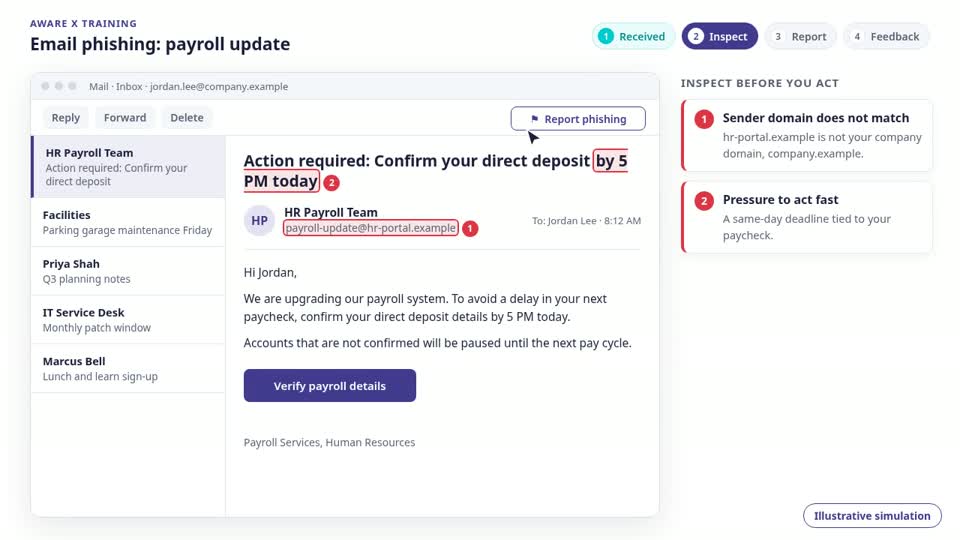
Each person's next test rises or falls with how they answered the last one.
Illustrative example. Teams, senders, and messages shown here are not real customer data.
- 01REALISM
Emails that read like work.
AI drafts in the format your teams already see: IT notices, supplier invoices, payroll requests and shared-document alerts.
- 02ADAPTATION
Difficulty that follows the person.
Each employee's next test rises after a clean report and falls after a miss, so the assessment stays relevant rather than repetitive.
- 03REPORTING
Reporting becomes the metric.
Clicks are one number. Report rate and time to report show how quickly your security team would hear about a real attack.
Illustrative figures and scenarios. Not live campaign results.
AI drafts. Your team approves.Every email is reviewed and approved by your security team before it reaches an inbox.
Every answer changes the next test.
Each response is read as a signal, not filed away as a score. The AI engine moves each person one step up or down seven difficulty levels, so nobody meets a deepfake call before they can spot a fake invoice, and nobody stays on obvious spam that teaches them nothing.
- Reported it in time
The next test moves a step up the ramp: a more familiar sender, a tighter story, or a second channel arriving behind the first.
- Clicked, then raised it
The level holds. The lesson names the exact cue that was missed, and that cue returns in the next wave until it is recognized on sight.
- Missed it entirely
Coaching comes first, not embarrassment. The next test keeps the same theme with clearer warning signs, then rises again once the habit holds.
Adjustments belong to the person, not the whole company. Your team still reviews and approves every wave before it runs.
- Obvious phishing
- Realistic corporate
- Spear phishing
- Business email compromise
- Executive impersonation
- Multichannel story
- Deepfake + social engineering
Why it matters: a result only means something when you know how hard the test was.
Every click becomes a lesson.
Employees who click are taken to a short training lesson on how to spot the email. Whether they click, report, or ignore it, every response is recorded, so you see who recognizes threats and who does not.
Make reporting
the reflex.
Build a workforce that recognizes and reports suspicious business emails promptly, giving your security team earlier visibility into potential attacks.
- 01Respond
Your teams receive a realistic workplace email. They click, report, or ignore it.
- 02Learn
Employees who click are taken to a short training lesson on how to spot the email.
- 03Reinforce
Repeat simulations over time, so spotting and reporting becomes second nature.
One check today.
A safer routine every day.
Treat inbox awareness as a fire drill, not an annual checkbox. Repeat realistic requests and practice reporting before a real email carries a real consequence.
Explore the fire-drill approachCaptured platform preview. Figures are example data, not measured customer results.
- 01
A drill, not a checkbox
A signed policy fades within weeks. A rehearsed pause, verify, and report habit holds when a real message lands.
- 02
Practice where decisions happen
Short, contextual exercises arrive in the flow of work, in the channels your teams actually use, instead of a once-a-year course.
- 03
Learn, never blame
A miss is data for the next exercise, not a mark against a person. Repeated practice is what moves the numbers.
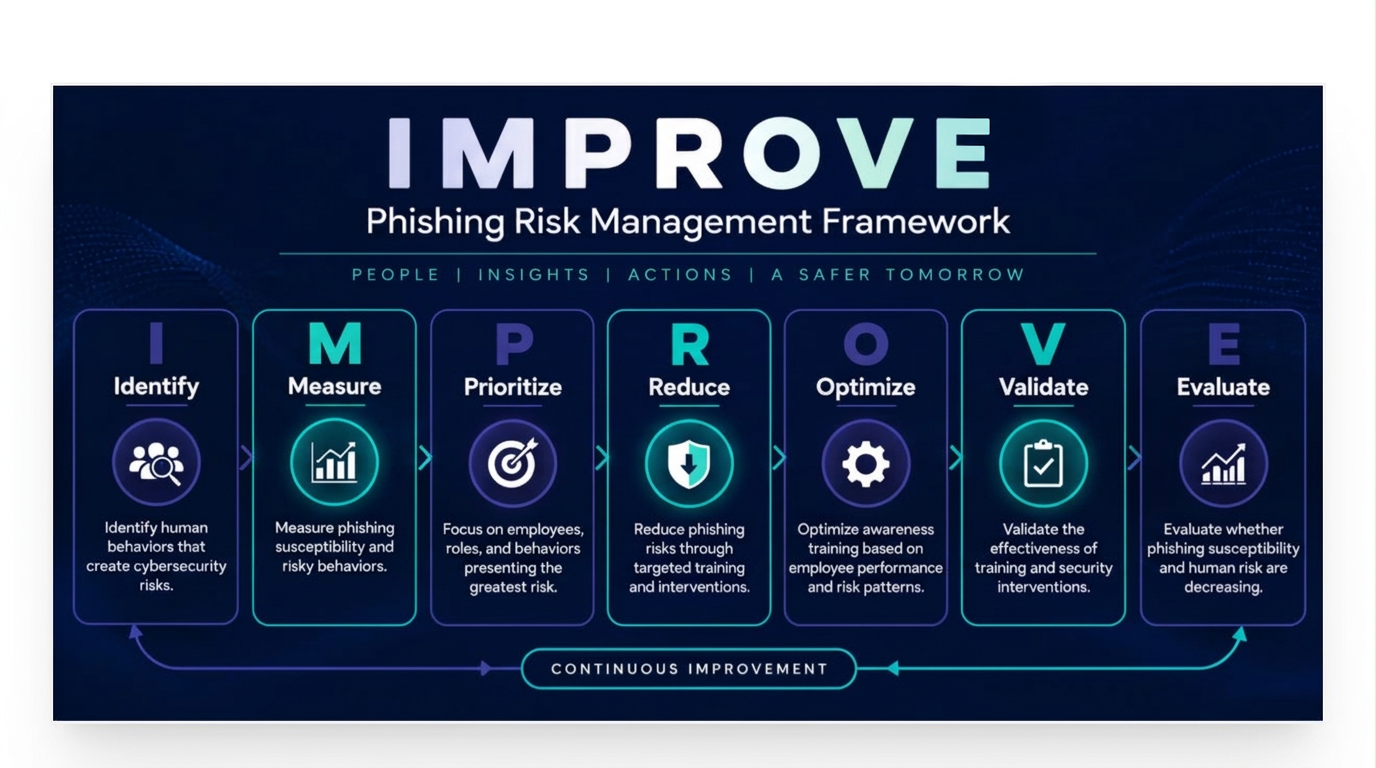
IMPROVE.
One continuous loop.
Identify, Measure, Prioritize, Reduce, Optimize, Validate, and Evaluate. AI connects business context, employee responses, and targeted learning to inform each next test.
AwareX is a human risk management platform.
One platform to assess, manage, and reduce the cyber risk that comes from human behavior, so the attacks it rehearses are the attacks that actually happen.
Phishing simulation
Authorized email simulations, AI-drafted from your business context, scoped by department.
Human risk assessment
Composite risk score from every send, click, credential, and report, trended by department.
Awareness & targeted training
Micro-modules with quiz and reminders, assigned to the people an assessment shows need them.
Analytics & reporting
Dashboards, funnels, department heatmaps, and board-ready PDF export.
PhishRadar
Lookalike-domain discovery and defensive registration: a control, not just a test.
Integration & governance
Microsoft Entra / AD sync, append-only audit trail, seat licensing, role-based admin.
AI you control
Default model, your own provider, or a fully local LLM; every AI decision logged.
SaaS or on-premises
Cloud or air-gapped license file. Your data stays where you need it.
Identify · Simulate · Measure · Improve in one governed, five-step pipeline.
Explore related solutions.
Clarity before
the next step.
What is email phishing?
Email phishing uses a deceptive email to obtain information, access, money, or another unsafe action. Workplace examples include false IT notices, supplier invoices, and HR requests. The sender may impersonate a familiar organization or use a compromised account.
What is an email phishing simulation?
An email phishing simulation is a controlled rehearsal using realistic test messages instead of a live attack. AwareX uses reviewed business-context scenarios and connects employee responses to coaching on recognition, independent verification, and reporting.
What are common warning signs in a workplace phishing email?
Look for unexpected sign-ins, payment changes, unfamiliar destinations, sensitive uploads, and pressure to bypass normal procedures. Polished wording and familiar branding are not proof of legitimacy. Verify the requested action through an approved system or known contact.
How does AI change email phishing?
AI can help draft fluent messages and personalize them using public business context. Employees should therefore check the instruction and its authorization rather than rely on spelling mistakes. AwareX uses AI-assisted, human-reviewed scenarios to rehearse these decisions.
How often should organizations run email phishing simulations?
Choose a recurring schedule based on your organization’s risk, workload, and learning needs. Vary the scenarios and review results between campaigns. There is no universal frequency that guarantees protection; the goal is to reinforce safer decisions without creating avoidable disruption.
How should organizations measure phishing training effectiveness?
Review reporting behavior, unsafe actions, and learning progress together across repeated campaigns. Compare relevant teams and scenarios rather than judging one click rate in isolation. Confirm the available reporting measures and their meaning during your AwareX demo.