Push Phishing and MFA Fatigue Training
An approval prompt looks like a safeguard, which is what makes an uninitiated one dangerous. AwareX rehearses the deny-and-report decision under approval pressure.
Explore the approachMFA protects access. An unthinking approval can undo the check.
Approving an unexpected MFA prompt can authorize the wrong sign-in. AwareX rehearses the deny-and-report decision under approval pressure.
During the offsite campaign review, a prompt asks for access from the venue Wi-Fi even though the employee has not started a sign-in.
Fictional workplace example, not a live attack or measured customer result.
- 01 / WHAT ROUTINE TRAINING MISSES
The prompt looks like a security safeguard.
Employees can mistake a familiar approval screen for proof that the underlying sign-in is legitimate.
- 02 / WHEN THE REQUEST FEELS REAL
Stopping the interruption can authorize the wrong sign-in.
Approving an uninitiated request can permit unauthorized access. Repeated prompts add pressure to make the interruption disappear.
- 03 / WHERE AWAREX CHANGES THE REHEARSAL
Practice the deny-and-report habit.
AwareX rehearses unexpected approval pressure in business context and reinforces that an uninitiated request must be denied and reported.
Routine compliance training vs. AwareX
Compliance learning establishes a foundation. AwareX puts AI behind the rehearsal: it studies your approved context, drafts the scenarios, and adapts what people practice next.
| What matters | Routine compliance training | AwareX approach |
|---|---|---|
| Starting point | A scheduled course built around policies and general awareness. | AI studies your approved business context first, so the first test reflects how you work. |
| Workplace relevance | The same broad examples for every responsibility. | AI drafts role-specific versions for finance, HR, IT, and leadership; your team approves each. |
| What people practice | Recognizing terms and selecting answers in a lesson. | AI adapts sender, story, tone, and difficulty from each response. |
| Follow-through | Completion often becomes the finish line; reinforcement is rarely built in. | AI reads each click, report, and pause, then sets the next round from the missed cue. |
| What success means | Attendance, course completion, and assessment scores. | The decisions people make in rehearsal, tracked by AI across rounds, not one quiz. |
This compares a completion-focused training approach, not every training provider. AI output is reviewed by your team before release, and capabilities and scope are confirmed in your demo. Training does not guarantee attack prevention, compliance, or certification.
From recognizing a message to rehearsing a response
Will the employee deny and report an approval request they did not initiate?
Rehearse the decisionExplain the missed cuePractice again
What is Push Phishing?
An approval prompt you did not start is an attack, not a nuisance. The exercise rehearses the response: deny, report, and never approve a sign-in you cannot place.
Timed to a plausible moment
Joining venue Wi-Fi, opening a shared workspace: the prompt arrives when it would be easy to believe.
Pressure that adapts
Repeated approval pressure adjusts to how each person responded before, so the rehearsal stays honest.
The decision is the result
The habit rehearsed is simple: an uninitiated prompt is a deny, every time.
During the offsite campaign review, a prompt asks for access from the venue Wi-Fi even though the employee has not started a sign-in.
Illustrative example. Prompt types and platforms in scope are confirmed with your team, and every scenario is reviewed and approved before it runs.
New to the term? Read the guide: What is MFA fatigue?
How AwareX AI makes it more effective.
A prompt at a believable moment. Pressure that follows the person. Coaching that makes the deny automatic.
One more prompt, one tired tap.
No generic templates. AwareX agents read what is happening at your company and build department-specific tests from it.
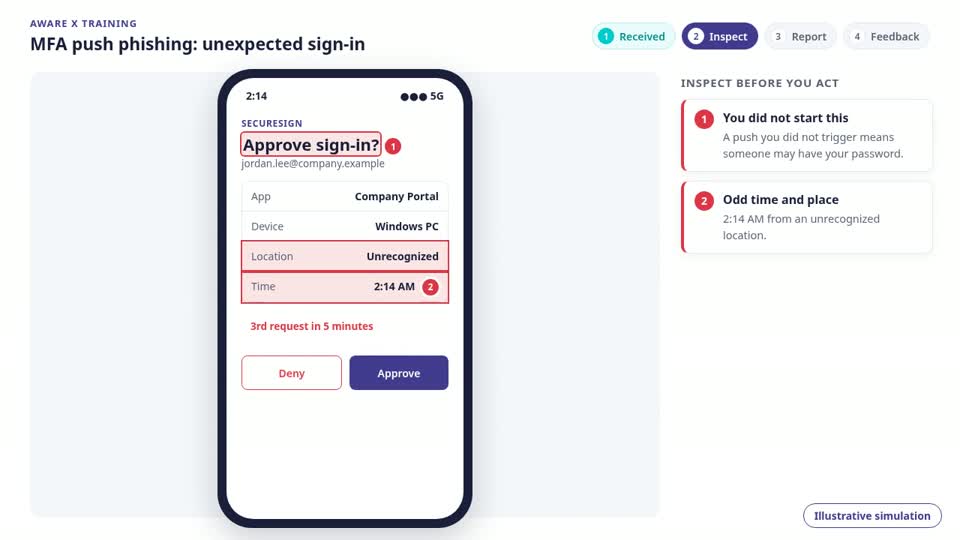
Illustrative example. Signals, names, and messages are not real customer data.
- 01TIMING
A prompt at a believable moment.
AI times the prompt to plausible activity, like joining venue Wi-Fi or opening a shared workspace, instead of a random interruption.
- 02ADAPTATION
Pressure that follows the person.
Prompt patterns adapt to how each person responded before, so the fatigue point is reached at the pace the assessment needs.
- 03COACHING
Coaching that makes the deny automatic.
Immediate coaching explains why an uninitiated prompt is a deny, every time.
Illustrative prompts and timings. Not live campaign results.
AI proposes. Your team decides.Every scenario is reviewed and approved by your team before it reaches an employee.
Every answer changes the next test.
Each response is read as a signal, not filed away as a score. The AI engine moves each person one step up or down seven difficulty levels, so nobody meets a deepfake call before they can spot a fake invoice, and nobody stays on obvious spam that teaches them nothing.
- Reported it in time
The next test moves a step up the ramp: a more familiar sender, a tighter story, or a second channel arriving behind the first.
- Clicked, then raised it
The level holds. The lesson names the exact cue that was missed, and that cue returns in the next wave until it is recognized on sight.
- Missed it entirely
Coaching comes first, not embarrassment. The next test keeps the same theme with clearer warning signs, then rises again once the habit holds.
Adjustments belong to the person, not the whole company. Your team still reviews and approves every wave before it runs.
- Obvious phishing
- Realistic corporate
- Spear phishing
- Business email compromise
- Executive impersonation
- Multichannel story
- Deepfake + social engineering
Why it matters: a result only means something when you know how hard the test was.
Every response becomes a lesson.
Employees who approve a prompt nobody asked for are taken to a short lesson on push fatigue. Whether they approve, deny, or report, every response is recorded, so you see who recognizes an uninitiated prompt and who does not.
Make denying
the reflex.
Build a workforce that denies and reports an unexpected sign-in prompt every time, giving your security team an earlier signal than any alert could.
- 01Respond
Your teams receive a realistic push prompt. They approve, deny, or report it.
- 02Learn
Employees who approve are taken to a short lesson on why an uninitiated prompt is always a deny.
- 03Reinforce
Repeat simulations over time, so denying the unexpected becomes automatic.
One check today.
A safer routine every day.
Run a fire drill for the approval moment. Practice denying uninitiated prompts and reporting repeated pressure, not approving to clear the screen.
Explore the fire-drill approachCaptured platform preview. Figures are example data, not measured customer results.
- 01
A drill, not a checkbox
A signed policy fades within weeks. A rehearsed pause, verify, and report habit holds when a real message lands.
- 02
Practice where decisions happen
Short, contextual exercises arrive in the flow of work, in the channels your teams actually use, instead of a once-a-year course.
- 03
Learn, never blame
A miss is data for the next exercise, not a mark against a person. Repeated practice is what moves the numbers.
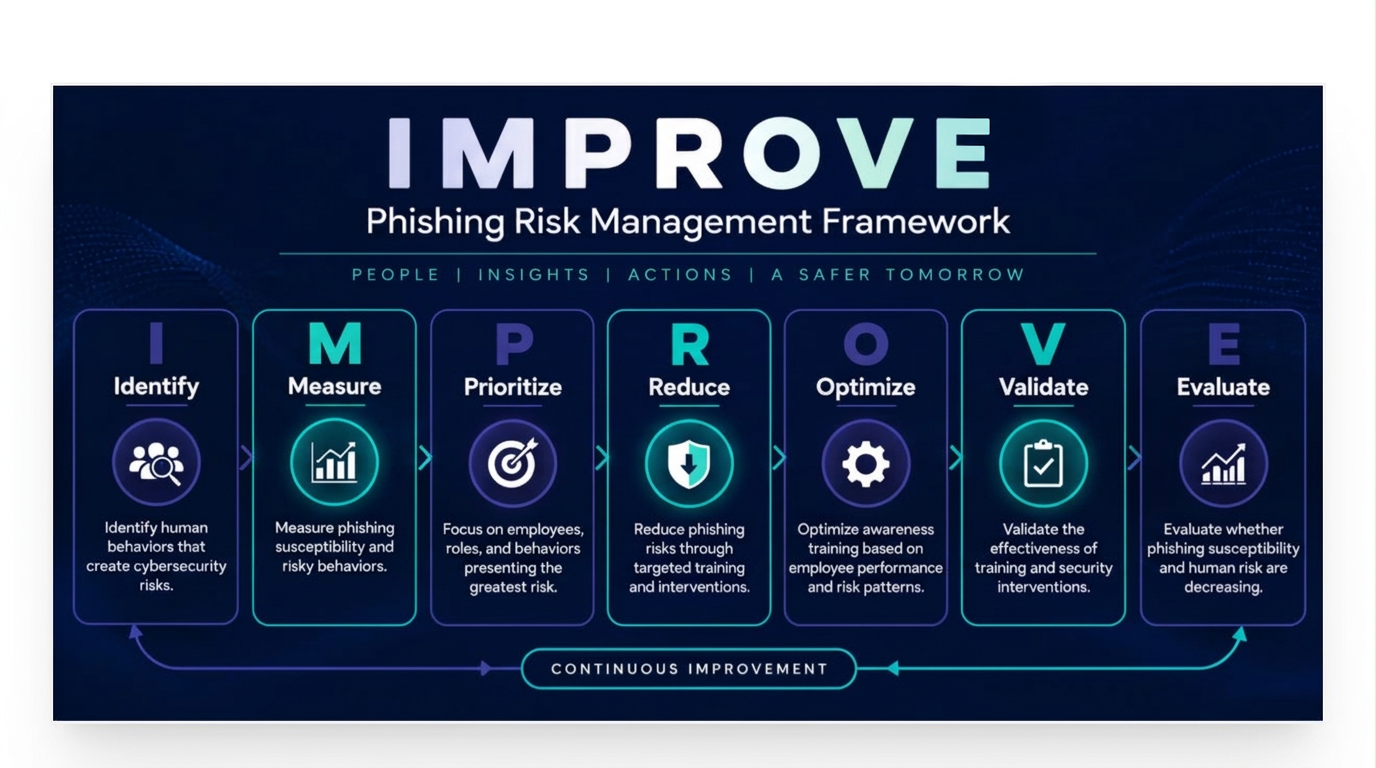
IMPROVE.
One continuous loop.
Identify, Measure, Prioritize, Reduce, Optimize, Validate, and Evaluate. AI connects business context, employee responses, and targeted learning to inform each next test.
Explore related solutions.
Clarity before
the next step.
What is push phishing?
Push phishing tries to trick someone into approving an unexpected multi-factor authentication (MFA) notification. The attack targets the sign-in approval decision. Receiving a prompt does not prove that you started or authorized the sign-in.
What is MFA fatigue or push bombing?
MFA fatigue, also called push bombing, uses repeated authentication requests to pressure a person into approving one. Repetition can create confusion or frustration, but it does not make a request trustworthy. Deny requests for sign-ins you did not initiate.
What should employees do with an unexpected MFA prompt?
Deny the request and report it through the approved security channel. Do not approve it just to stop notifications or because a caller tells you to. If you already approved it, notify your security team immediately and follow its incident response instructions.
How does AwareX push phishing simulation help employees?
AwareX rehearses the decision to approve, deny, or report a simulated sign-in request. Reviewed scenarios use plausible workplace moments, and coaching explains the central cue: the employee did not start the sign-in.
How does AI support push phishing training?
AwareX AI proposes scenarios around business activity and adapts pressure patterns to earlier responses. Your team approves the scenario before delivery. Follow-up coaching reinforces denying and reporting an uninitiated request rather than accepting a familiar-looking prompt.
Can MFA fatigue training replace stronger authentication?
No. Training supports safer responses but does not replace technical authentication controls. Security teams should evaluate phishing-resistant authentication and other appropriate protections while teaching employees to deny and report unexpected prompts.