What Is Vishing?
Vishing is phishing over a voice call. A caller impersonates a trusted person or organization, such as IT support, a bank, or an executive, and uses urgency or authority to make you share information or approve an action. The word combines voice and phishing.
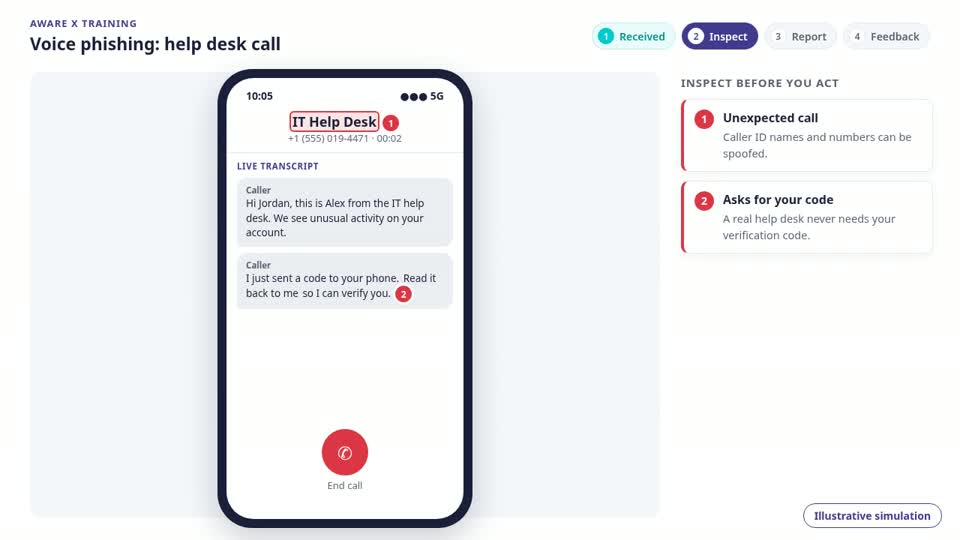
Examples of vishing
Vishing calls sound helpful and confident. Common shapes include:
- A caller claiming to be IT support says your account is compromised and asks you to read out a one-time code.
- Someone posing as an executive requests an urgent payment and asks you not to tell anyone yet.
- A caller pretending to be your bank’s fraud team asks you to move money to a safe account.
How to verify a caller
A confident voice is not proof of identity. Before acting on any unexpected call:
- Never share passwords, one-time codes, or approve access requests on an inbound call.
- End the call and contact the person or organization on a number you already trust, not one the caller gives you.
- Treat pressure to stay on the line or keep the call secret as a warning sign.
- Report the call to your security team with the number and details.
Clarity before
the next step.
What is a vishing attack?
A vishing attack is a phone call where the caller pretends to be someone trustworthy to steal information, money, or access. Caller ID and a professional tone do not prove the caller is real.
Is vishing the same as voice phishing?
Yes. Vishing is short for voice phishing. Both terms describe social engineering over a phone or voice conversation.
Can you train staff against vishing?
Yes. Awareness training builds the habit of ending unexpected sensitive calls and verifying through an independently trusted channel.