


An unusual approval path
A familiar person asks you to bypass payment, access, or verification controls.
Meet AwareX: human preparedness for convincing requests, including the email-to-Teams deepfake-call experience.
Where we test
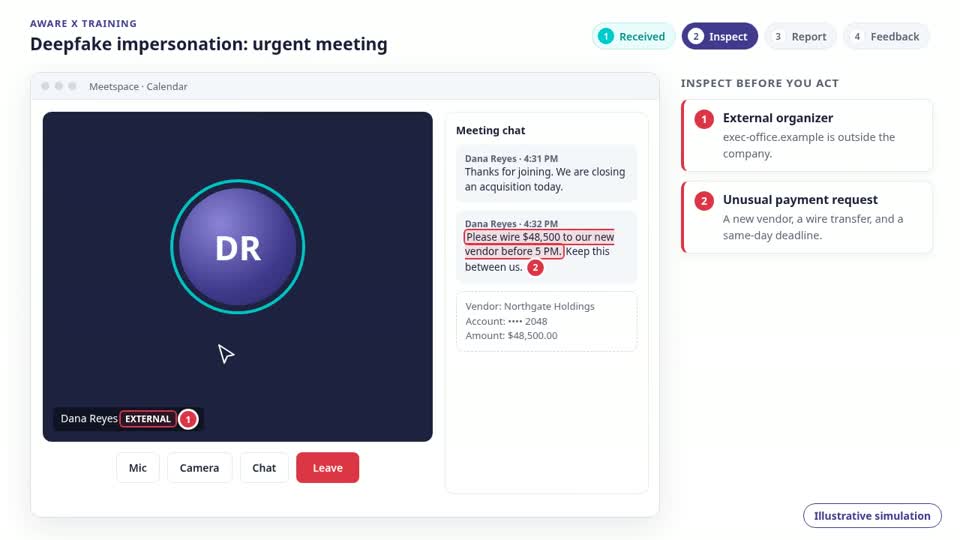
AI-assisted impersonation can make deceptive messages more convincing. Synthetic faces or voices may be used to impersonate a familiar person, but a realistic appearance is not proof that a sensitive instruction is authorized.
An email invites a finance employee into a Teams call that appears to feature an executive. The caller requests an urgent transfer outside the usual approval process. The critical question is whether the instruction is independently authorized.
A familiar person asks you to bypass payment, access, or verification controls.
The request demands immediate action and discourages speaking to anyone else.
A face or voice is offered as a substitute for an independently confirmed instruction.
Pause sensitive actions even when a face or voice appears familiar.
Verify through a known independent channel and follow established approvals.
Escalate unexpected calls or requests using your organization’s reporting process.
The supplied AwareX presentation describes an email-to-Microsoft Teams deepfake-call experience. Discuss how the scenario supports verification habits and contextual coaching under human-approved testing.
AwareX is not a media-authenticity detector. Deepfake generation and standalone voice simulations are not offered in the current presentation scope.
Visual or audio oddities may raise concern, but their absence does not prove authenticity. The safer habit is independently verifying sensitive requests and keeping approval controls intact.
The form is available to preview, but delivery is not yet connected. Submitting it does not send or save your details.